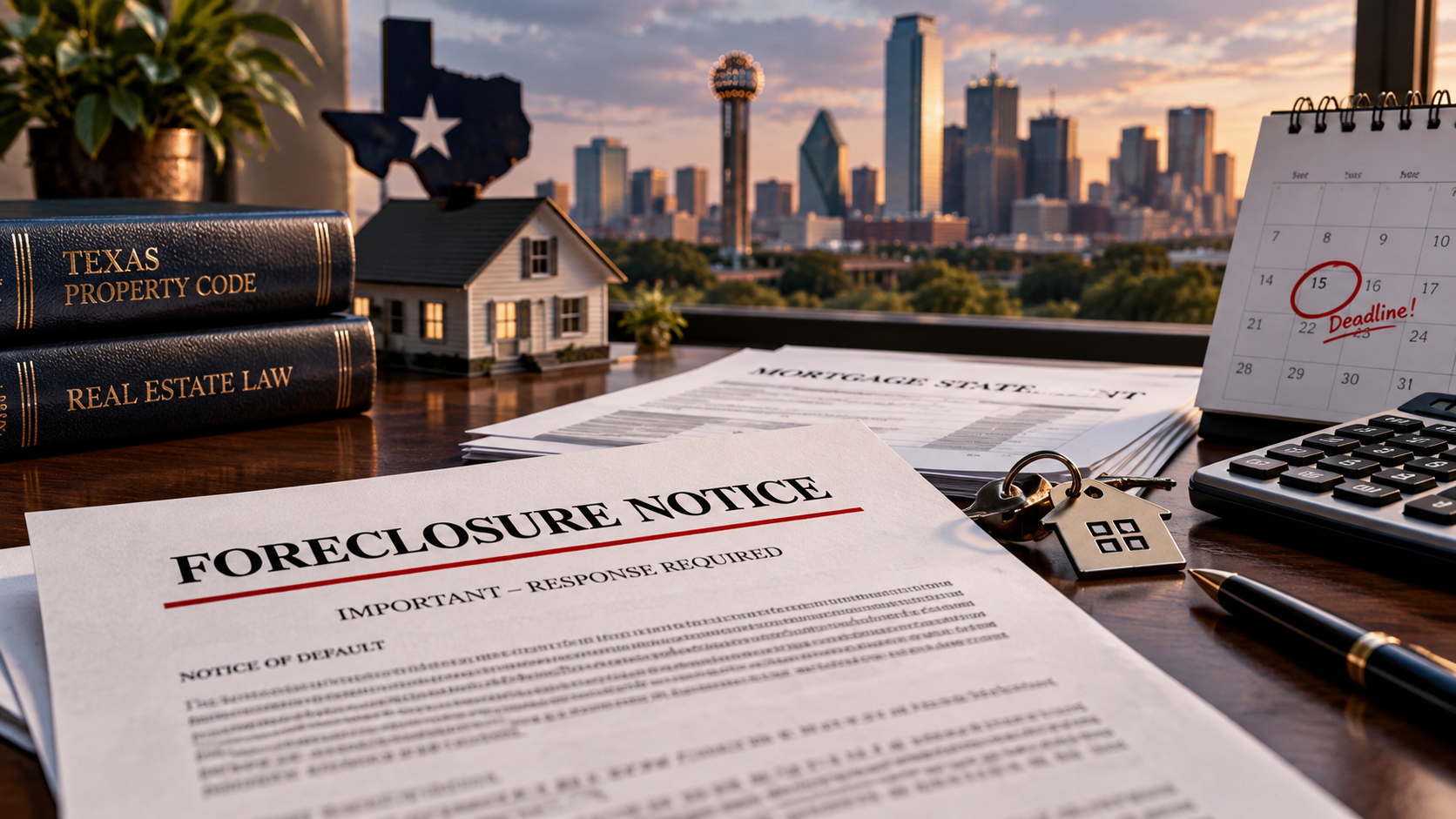

What a Texas Foreclosure Notice Means
Texas Foreclosure Notice: Take It Seriously, But Do Not Panic
Receiving a Texas Foreclosure Notice can be one of the most stressful letters a homeowner ever opens. Seeing words such as default, acceleration, or foreclosure sale can make it feel as though the loss of the home is already inevitable.
That conclusion may be premature.
The first step is to slow down long enough to understand exactly what you received. A foreclosure-related document can relate to different stages of the process, and the deadline printed on the page may be extremely important.
Texas law contains specific requirements governing foreclosure notices and sales. For example, Texas Property Code §51.002 establishes statutory procedures concerning notice to a debtor and notice of a foreclosure sale. The exact requirements depend on the circumstances and the type of proceeding involved.
Start With These Three Questions
After receiving a notice, immediately ask:
- What type of document is this?
- What deadline or date does it identify?
- What action does it require from me?
Do not assume that every foreclosure letter means a sale has already been scheduled.
Likewise, do not assume that a deadline can safely be ignored because you intend to contact the lender later.
Timing matters.
Federal mortgage-servicing rules can also become relevant in certain situations involving loss-mitigation applications. For qualifying borrowers, protections can depend on when a complete application is received relative to a scheduled foreclosure sale.
That is why your first response should be organized rather than emotional.
Read the entire document. Save the original. Make copies. Mark every date. Then begin gathering the mortgage statements, payment records, and previous correspondence that may explain how the situation developed.
The goal of this first step is simple: understand exactly where you stand before making your next move.

Identify Exactly What Notice You Received
2. Determine What Type of Texas Foreclosure Notice You Have
One of the most important things a homeowner can do after receiving a Texas Foreclosure Notice is determine exactly what document was received. Not every foreclosure-related letter means the property is already scheduled for sale, and different notices can signal different stages of the process.
Look at the heading, date, sender, and instructions carefully. Common foreclosure-related documents may include a notice of default, a notice concerning an opportunity to cure, a notice of acceleration, or a notice of foreclosure sale.
These documents should not be treated as though they mean the same thing.
Look for These Details
When reviewing the document, identify:
- Who sent it
- Why it was sent
- What amount is allegedly past due
- Whether the loan has been accelerated
- Whether a foreclosure sale date is listed
- What deadline applies
- Where and how you are supposed to respond
Texas Property Code §51.002 establishes statutory procedures concerning foreclosure notices. The law addresses notice to a debtor and separately establishes requirements for notice of a foreclosure sale, including the statutory notice period applicable to a sale.
That distinction matters because a homeowner should not automatically interpret an earlier delinquency or default notice as proof that the house is about to be sold.
At the same time, you should never assume an earlier notice is unimportant.
Every date deserves attention.
Do Not Rely Only on the Document Title
A document’s title can be helpful, but the surrounding language matters too. Read the entire notice rather than looking only for the word foreclosure.
Pay particular attention to language concerning:
- Cure rights
- Acceleration
- Sale dates
- Payment requirements
- Loss-mitigation options
- Response deadlines
Federal mortgage-servicing regulations can also affect borrowers pursuing loss-mitigation options. Under current Regulation X, specific procedures can apply when a servicer receives a complete loss-mitigation application sufficiently before a scheduled foreclosure sale.
The practical lesson is straightforward: identify the document before deciding what action to take.
A homeowner who correctly identifies the notice can build a much clearer timeline, recognize the most urgent deadline, and determine whether professional legal review is warranted professional legal review.
Verify the Details Before You Respond
3. Check the Property, Loan, Servicer, and Amount
After identifying the document, the next step is to compare the Texas Foreclosure Notice with your own mortgage records. Do not assume that every figure or piece of information in the notice is correct simply because it came from the lender or servicer.
Start with the basic identifying information. Confirm that the property address, borrower name, loan number, and mortgage servicer match your records.
Then examine the amount the notice says you owe.
Compare the Notice With Your Records
Look for possible differences involving:
- Missed payment dates
- Payment amounts
- Late charges
- Escrow amounts
- Fees or other charges
- The stated loan balance
- The date the account allegedly went into default
Gather recent mortgage statements and payment confirmations so you can compare the lender’s information against your own records.
A discrepancy does not automatically mean the foreclosure is invalid. However, an unexplained difference is a reason to investigate rather than ignore the issue.
Check Who Is Servicing the Loan
Mortgage loans can sometimes change servicers. If the company named in your notice is different from the company shown on your more recent mortgage statement, determine when the servicing relationship changed and preserve the related correspondence.
Federal mortgage-servicing rules address matters such as servicing transfers, error resolution, requests for information, and loss mitigation. These federal protections operate alongside applicable state foreclosure law.
You should also look for inconsistencies between the notice and your payment history.
For example, ask:
- Did I actually miss the payment the notice identifies?
- Was a payment credited to the correct account?
- Was a payment made but not reflected on the statement?
- Did the amount owed change without an explanation?
- Have I previously disputed an account error?
Keep copies of anything supporting your position.
Why This Verification Matters
Texas foreclosure procedures contain specific statutory requirements, including rules governing notices connected with a foreclosure sale.
That does not mean a homeowner should try to determine a legal violation from one document alone.
Instead, your immediate objective is to create an accurate record of what the lender says happened versus what your records show actually happened.
Do not alter, discard, or overwrite original documents.
A clean record can make the next step—whether communicating with the servicer, pursuing loss mitigation, or obtaining legal review—far more productive.

Calendar Every Deadline
4. Put Every Important Foreclosure Date on Your Calendar
Once you understand what document you received, the next move is to identify every deadline connected to the Texas Foreclosure Notice.
Do not rely on memory. Do not assume you can calculate a legal deadline later. Write the dates down immediately and keep a copy of the notice with your records.
Create a Foreclosure Deadline Checklist
Look for:
- The date printed on the notice
- The date you actually received it
- Any deadline to cure the default
- Any response deadline
- Any deadline for submitting documents
- Any scheduled foreclosure sale date
- Any date associated with a loss-mitigation application
Texas law establishes specific notice requirements for foreclosure sales, while the applicable timing can depend on the type of foreclosure and the facts surrounding the loan. Texas Property Code §51.002 contains the statutory requirements governing notices connected with a sale.
That makes one rule especially important:
Never assume that the date you notice first is the only date that matters.
Work Backward From the Most Urgent Date
Suppose your documents identify a foreclosure sale date. That date should immediately become the central point of your timeline.
Then work backward.
Ask:
- When was the notice sent?
- When did I receive it?
- What response was requested?
- When did I first fall behind?
- Have I submitted anything to the servicer?
- Has the servicer acknowledged receiving it?
- Are additional documents required?
Federal Regulation X also contains timing rules for qualifying loss-mitigation applications. For example, when a servicer receives a complete application more than 37 days before a foreclosure sale, specific evaluation procedures can apply; other protections depend on when the application is received and other circumstances.
That does not mean submitting an application automatically cancels a foreclosure or guarantees a loan modification. The actual protections depend on the facts and applicable requirements.
The safest approach is simple: treat every date as important until you know otherwise.
Early organization gives you time to investigate instead of forcing you to make decisions under last-minute pressure.
Gather Your Mortgage and Foreclosure Records
5. Build One Complete Foreclosure File
After reviewing the notice and identifying the deadlines, the next step is to gather the records that explain how you got there. Do not rely on the foreclosure letter alone.
Create one folder—digital, physical, or both—and place every important mortgage and foreclosure document inside it.
Gather These Records First
Your file should include:
- Recent mortgage statements
- Payment confirmations and bank records
- The loan agreement and deed of trust, if available
- Every foreclosure-related notice
- Letters from the mortgage servicer
- Emails, text messages, and online messages
- Loan-modification or loss-mitigation applications
- Documents submitted to the servicer
- Approval or denial letters
- Proof of income and relevant financial records
- Insurance or escrow correspondence
- Notes from telephone conversations
Keep both the documents you sent and the documents you received.
Build a Chronological Timeline
Arrange the records by date.
For example:
- First missed payment
- Servicer communication
- Notice of default
- Payment or attempted payment
- Loss-mitigation application
- Servicer response
- Foreclosure notice
- Scheduled sale date
This timeline can reveal gaps or inconsistencies that are difficult to spot when documents are scattered across email accounts, drawers, and online portals.
Federal mortgage-servicing rules address recordkeeping, error resolution, information requests, and loss-mitigation procedures.
Keep Evidence of What You Submitted
If you have applied for a loss-mitigation option, keep proof showing when you submitted the application and exactly what you provided.
Under Regulation X, a servicer receiving a loss-mitigation application may have obligations concerning whether the application is complete and what additional information or documents are required.
That makes submission records important.
Do not delete old emails or throw away previous foreclosure letters simply because you received a newer document.
Organize Before You Negotiate
A complete file gives you something more valuable than a stack of paperwork: a usable factual history.
When you eventually speak with the servicer, housing counselor, or foreclosure attorney, you can explain what happened using dates and documents instead of memory.
That can make the review faster and reduce the risk of overlooking an important communication or deadline.

Contact the Mortgage Servicer Carefully
6. Contact the Servicer and Ask What Options Remain
Once your records are organized, do not simply wait for another letter. Contact the mortgage servicer and find out what the company currently shows on your account.
When dealing with a Texas Foreclosure Notice, the goal of the conversation is not merely to ask, “Can you stop the foreclosure?” You need specific information that can be documented and verified.
Ask the Servicer These Questions
Depending on your situation, ask:
- What is the current amount required to bring the loan current?
- Has the loan been accelerated?
- Is a foreclosure sale currently scheduled?
- What date is associated with that sale?
- Is my account being reviewed for loss mitigation?
- What documents are required from me?
- What is the deadline for submitting those documents?
- Who should receive my paperwork?
Write down the representative’s name, the date and time of the call, the department you reached, and everything you were told.
Do not depend on a telephone conversation alone.
After submitting documents, retain confirmation that they were received. Keep copies of applications, supporting financial information, emails, and any written responses from the servicer.
Federal mortgage-servicing rules contain procedures concerning loss mitigation and requests for information. In qualifying circumstances, a servicer may have specific obligations after receiving a loss-mitigation application, including rules concerning acknowledgment, evaluation, and available options.
Do Not Assume an Application Stops Everything
Submitting a loss-mitigation application does not automatically mean a foreclosure sale is canceled.
The applicable protections can depend on factors including the status of the loan, the timing of the application, whether the application is complete, and the relationship between the application and any scheduled sale.
That is why you should continue monitoring every deadline even after contacting the servicer.
If the company gives you conflicting answers, ask for the information in writing and preserve the response.
Your objective is to create a documented record showing what you asked, when you asked it, what the servicer said, and what you submitted.
That record may become important when you evaluate your next steps with a qualified professional.
Preserve Every Document and Communication
7. Keep a Complete Record of Everything
After contacting the servicer, your next priority is preserving the evidence surrounding your Texas Foreclosure Notice. A foreclosure dispute can involve numerous letters, payment records, emails, applications, and telephone conversations. A missing document can make it much harder to reconstruct what happened and when.
Do not rely on memory.
Create one dedicated foreclosure file and save every relevant communication in it.
Keep These Documents Together
At minimum, preserve:
- The original foreclosure notice
- Previous default or delinquency notices
- Mortgage statements
- Bank records showing payments
- Payment confirmations
- Loan-modification applications
- Loss-mitigation documents
- Emails and online messages
- Letters from the mortgage servicer
- Certified-mail receipts
- Tracking information
- Written responses from the servicer
- Notes from telephone conversations
- Documents submitted to the lender or servicer
Whenever possible, keep the original document and a separate copy.
Record Your Telephone Calls
A simple call log can become extremely useful.
After each conversation, write down:
Date: When did the conversation occur?
Representative: Who did you speak with?
Department: Which department handled the call?
Purpose: Why did you call?
Information provided: What did the representative tell you?
Next action: What were you instructed to do?
Deadline: Was a specific date mentioned?
Do not treat an undocumented verbal promise as though it were a formal written agreement. Ask for important decisions, instructions, and confirmations in writing whenever possible.
Federal mortgage-servicing rules include provisions addressing requests for information and notices of error, which can make written documentation particularly important when a borrower believes the account contains an error.
Build a Simple Timeline
A basic timeline can make a complicated situation much easier to understand:
| Date | Event | Evidence |
|---|---|---|
| March 1 | Payment made | Bank record |
| March 15 | Servicer contacted | Call notes |
| April 2 | Notice received | Original letter |
| April 10 | Documents submitted | Confirmation |
| April 18 | Servicer responded |
Do not delete older records simply because you received a newer notice.
Your objective is to preserve a clear history of the account so that you, your servicer, housing counselor, or attorney can understand what happened without relying on assumptions.

Get Legal Review and Do Not Ignore the Notice
8. Have the Notice Reviewed Before You Assume the Worst
The final step is to decide whether you need professional legal review of your Texas Foreclosure Notice and the timeline you have assembled.
By this point, you should have the notice, mortgage records, payment history, communications, and important dates organized. That gives an attorney a much better starting point than simply saying, “I received a foreclosure letter.”
Consider Prompt Legal Review When:
- A foreclosure sale date has been scheduled.
- You believe the amount claimed is inaccurate.
- Your payments may have been misapplied.
- You received conflicting notices.
- You submitted loss-mitigation documents and are unsure whether they were properly reviewed.
- You believe a required notice may be missing.
- You do not understand your deadline.
- The servicer has stopped responding.
- You have received documents concerning acceleration or a trustee’s sale.
Texas Property Code §51.002 contains specific requirements concerning residential foreclosure notices. For example, the statute generally requires at least 20 days for a residential debtor to cure a default before notice of sale may be given, and a notice of sale generally must be given at least 21 days before the sale. The exact application depends on the circumstances and the governing loan documents.
Federal law may also matter. Under Regulation X, a servicer that receives a complete loss-mitigation application more than 37 days before a foreclosure sale generally has specified evaluation obligations, subject to the regulation’s requirements and exceptions.
Those rules do not mean every homeowner can automatically stop foreclosure, obtain a loan modification, or challenge a sale. They mean the facts and timing deserve careful evaluation.
Do Not Wait Until the Last Minute
A foreclosure notice is a warning to act—not a document to put in a drawer.
Your nine-step response is straightforward:
- Read the notice carefully.
- Identify the type of notice.
- Verify the loan and account information.
- Calendar every deadline.
- Gather your records.
- Contact the servicer.
- Preserve every communication.
- Seek legal review when appropriate.
- Do not ignore the situation.
The earlier you understand your position, the more informed your next decision can be.
For Dallas homeowners facing foreclosure, Cerreta Law can review the circumstances and explain potential foreclosure-defense options based on the specific documents and timeline involved. Homeowners dealing with foreclosure alongside broader debt problems can also review Cerreta Law’s bankruptcy options before choosing a path forward.